
If you have been working in marketing for a while, you have probably noticed something strange happening in search advertising.
The old way of doing Search Engine Marketing does not work the way it used to.
Years ago, running a search campaign was pretty straightforward. You picked a handful of Search Engine Marketing keywords, wrote ads, and adjusted bids until the numbers looked good.
Search Engine Marketing queries were short, predictable and easy to group.
That world is disappearing.
Todays search landscape is messier, more conversational and heavily influenced by Artificial Intelligence.
The Shift From Search Engine Marketing Keywords to Intent
For a time, search marketing revolved around Search Engine Marketing keywords.
Advertisers focused on phrases like ” running shoes” or “cheap flights” or “plumber near me”.
These short queries made campaign targeting simple.
If your ad matched the Search Engine Marketing keyword, you were in business.
In 2026, people search very differently.
After typing a couple of words, they might say something like “What are the best running shoes for flat feet that don’t hurt my knees?”
That single search contains layers of intent:
- Product type
- Health concern
- Performance expectation
- Buying consideration.
From a Search Engine Marketing perspective, this changes everything.
Search Engine Marketing campaigns are no longer about matching words.
They are about understanding the problem behind the search.
Artificial Intelligence Is Reshaping How Ads Are Triggered
Search engines are much smarter now.
Platforms like Google use Artificial Intelligence models to interpret what people mean rather than simply matching the words they typed.
That means your ads can show up for searches that do not even contain your Search Engine Marketing keyword.
For example, if you bid on “running shoes”, your ad might appear for queries like “shoes that help with knee pain when jogging”, “best sneakers for long distance walking”, or “comfortable shoes for people who run every morning”.
This is great when the system understands intent correctly.
It can also create challenges.
Artificial Intelligence-driven matching sometimes connects your ads with searches that’re informational instead of transactional, which can lead to wasted ad spend.
That is why monitoring your Search Term Report has become more important than ever.
The Search Term Report Is More Valuable Than Ever
If there is one report every Search Engine Marketing specialist should check regularly, it is the Search Term Report.
This report shows the actual queries people used before clicking your ads.
Not the Search Engine Marketing keywords you selected.
The real searches.
In today’s environment, those searches often look very different from the Search Engine Marketing keywords in your campaign.
You might discover things like conversational queries or questions people ask before buying, or completely unexpected search phrases or new opportunities you had not considered.
Reviewing this data regularly helps you add Search Engine Marketing keywords, discover new high-intent phrases, improve targeting or reduce wasted budget.
In ways, the Search Term Report is the closest thing marketers have to hearing the customer’s thought process.
Search Is Becoming Conversational
One of the biggest reasons Search Engine Marketing is changing is the rise of voice search and Artificial Intelligence assistants.
When people speak of type, they naturally use longer, more conversational language.
For example, typed search is “pizza near me”. Voice search is “Where can I order good pizza nearby that’s open late?”.
These conversational searches contain context that helps Artificial Intelligence understand intent.
For advertisers, this means Search Engine Marketing campaigns must adapt.
When targeting only short phrases, marketers need to think about questions, problems or real-life situations.
Search Engine Marketing Campaigns Now Focus on Problems, Not Products
Traditional Search Engine Marketing campaigns were structured around products.
You might have ad groups like “running shoes”, “hiking shoes” or “sports sneakers”.
Modern search behaviour suggests a different approach.
People search based on problems.
For example, “shoes for knee pain while running” or “comfortable shoes for standing all day”, or “lightweight sneakers for travel”.
These searches reflect intent, not just product categories.
Smart advertisers are starting to structure Search Engine Marketing campaigns around these real-world needs.
Of targeting only product Search Engine Marketing keywords, they create content and ads that address the problem the user wants to solve.
The Role of Landing Pages Is Changing
Another major shift in Search Engine Marketing involves landing pages.
In the past, landing pages focused heavily on product features. Calls to action like “Buy Now” or “Get Started”.
Modern search behaviour requires a more helpful approach.
When someone searches for a question, they expect an answer.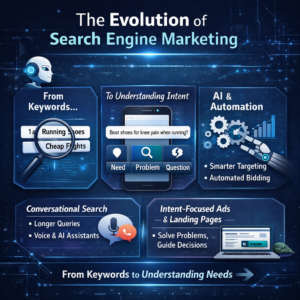
If a user clicks an ad asking “How do I choose the running shoes for flat feet?” and lands on a page that immediately pushes a purchase, the experience feels disconnected.
Search engines notice this mismatch.
When users bounce your Quality Score quickly, ad performance can suffer.
The performing landing pages now combine helpful information, clear solutions and relevant products or services.
Instead of pushing the sale immediately, they guide users through the decision process.
Automation Is Becoming the New Normal
Another big change in Search Engine Marketing is the rise of automation.
Platforms now offer automated bidding strategies and responsive ads, and Artificial Intelligence-driven campaign optimisation.
These tools can analyze amounts of data much faster than humans.
They adjust bids and test ad combinations. Identify patterns across millions of searches.
Automation does not replace strategy.
It simply shifts the marketer’s role.
Of manually adjusting every bid, Search Engine Marketing specialists now focus on campaign structure, audience intent, creative messaging and data interpretation.
Automation handles the mechanics and humans handle the strategy.
The Future of Search Engine Marketing
Search is no longer about Search Engine Marketing keywords.
It is about understanding how people think when they are trying to solve a problem.
In 2026, Search Engine Marketing is evolving into something human.
Search queries are longer.
Intent is more complex.
Artificial Intelligence plays a role in connecting ads with users.
For marketers, this means adapting to a world where conversations replace Search Engine Marketing keywords, and intent matters more than volume and search data reveals real customer behaviour.
The tools may be more advanced. The goal has not changed.
Successful Search Engine Marketing campaigns still come down to one thing: understanding what people need and showing up with the answer, at the right moment.