Digital marketing has moved from being a “nice to have” to the single biggest driver of business growth for companies of every size. Whether you run a local service business or manage a national e-commerce brand, your ability to compete online now depends on how well you understand and execute digital marketing — including its core pillars: SEO, SEM, and SMM.
In this guide, we break down what digital marketing really means today, why it matters more than ever, and how each major channel — search engine optimisation, search engine marketing, and social media marketing — fits into a winning strategy.
What Is Digital Marketing?
Digital marketing refers to any marketing effort that uses the internet or an electronic device to connect with current and prospective customers. It covers a wide range of tactics and channels, including websites, search engines, social media, email, content, and paid advertising.
Unlike traditional marketing — billboards, print ads, TV commercials — digital marketing is measurable, targeted, and adaptable in real time. You can track exactly how many people saw your ad, clicked it, and converted into a customer. That level of insight is why digital marketing budgets have grown steadily every year, and why businesses that ignore it fall behind quickly.
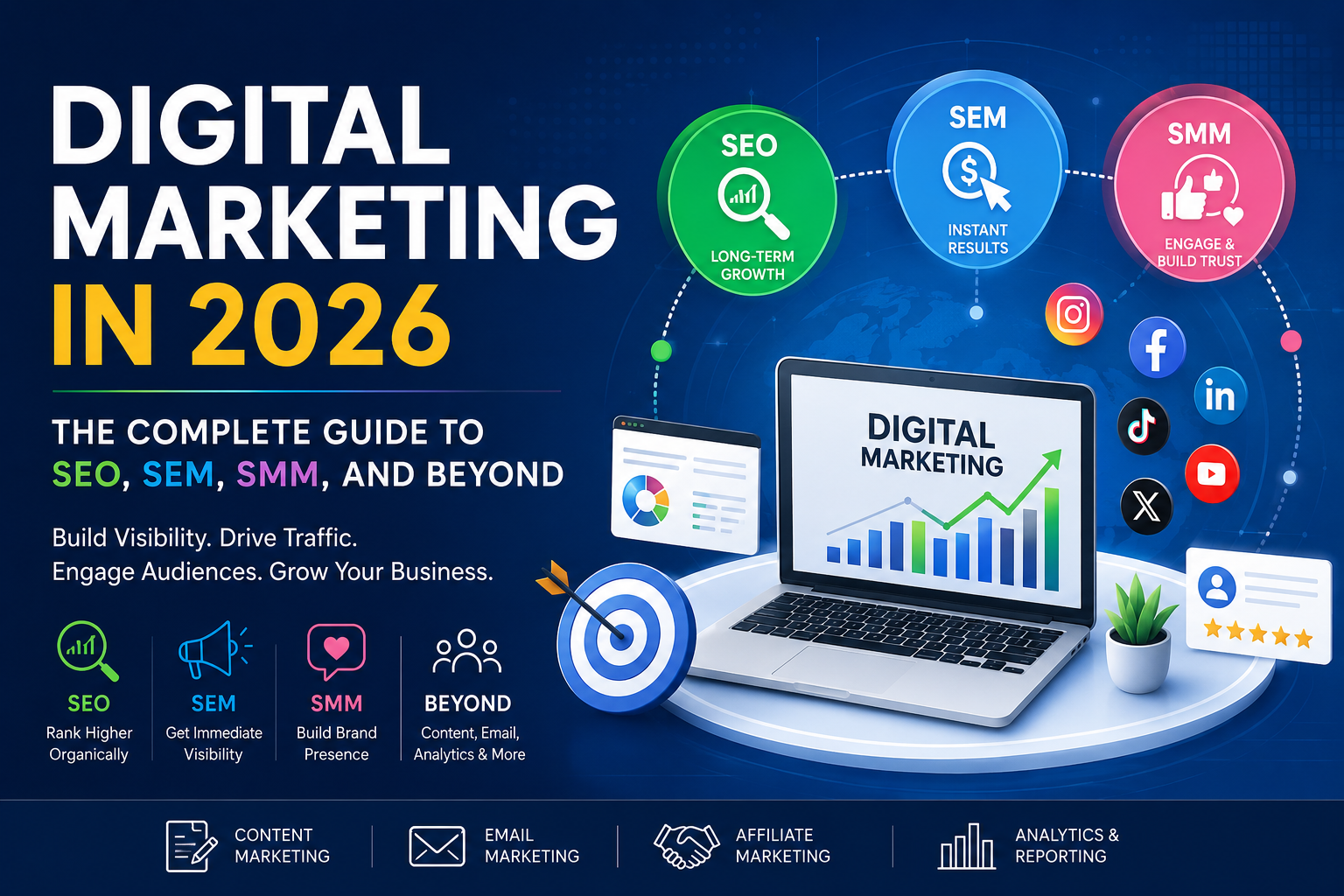
At its core, digital marketing is built on a few essential pillars:
- Search Engine Optimisation (SEO) — improving organic visibility on search engines
- Search Engine Marketing (SEM) — paid advertising on search engines
- Social Media Marketing (SMM) — building brand presence and engagement on social platforms
- Content Marketing — creating valuable content to attract and retain an audience
- Email Marketing — nurturing leads and customers directly
- Affiliate and Influencer Marketing — leveraging partners to expand reach
Let’s look at the three most important channels in detail: SEO, SEM, and SMM.
SEO: The Foundation of Long-Term Digital Marketing Success
Search Engine Optimisation (SEO) is the practice of improving a website so it ranks higher in organic (unpaid) search results. When someone searches for a product, service, or piece of information on Google, SEO determines whether your website shows up on page one — or gets buried on page ten, where almost nobody looks.
Why SEO Matters
Organic search remains one of the largest sources of website traffic for most industries. Unlike paid ads, which stop generating traffic the moment you stop paying, SEO builds compounding, long-term value. A well-optimised page can continue driving traffic and leads for years with minimal ongoing investment.
Core Components of SEO
- On-Page SEO — optimising individual pages with target keywords, meta titles, meta descriptions, header tags, internal linking, and high-quality content that directly answers user intent.
- Technical SEO — ensuring your website is fast, mobile-friendly, secure (HTTPS), crawlable, and free of broken links or duplicate content issues.
- Off-Page SEO — building authority through backlinks from reputable websites, brand mentions, and digital PR.
- Local SEO — optimising for location-based searches through Google Business Profile, local citations, and reviews — critical for businesses that serve specific geographic areas.
- Content SEO — publishing content that thoroughly answers what users are searching for, structured in a way search engines can understand and rank effectively.
The SEO Process
Effective SEO starts with keyword research to understand what your audience is actually searching for. From there, it involves auditing your current site, fixing technical issues, optimising on-page elements, building topical authority through content, and earning quality backlinks. SEO is not a one-time project — it’s an ongoing process that requires consistent monitoring, testing, and refinement as search engine algorithms evolve.
SEM: Driving Immediate Visibility Through Paid Search
Search Engine Marketing (SEM) refers to paid advertising that appears on search engine results pages, most commonly through platforms like Google Ads and Microsoft Advertising. While SEO is often described as the “free” traffic strategy, SEM is the fastest way to appear at the top of search results — often within hours of launching a campaign.
How SEM Works
SEM operates primarily on a pay-per-click (PPC) model, meaning advertisers only pay when someone clicks their ad. Ads are triggered by specific keywords and shown to users actively searching for related terms, making SEM one of the most intent-driven forms of advertising available.
Key Elements of a Successful SEM Campaign
- Keyword targeting — selecting high-intent keywords relevant to your product or service
- Ad copywriting — crafting compelling headlines and descriptions that drive clicks
- Landing page optimisation — ensuring the page users land on is relevant, fast, and conversion-focused
- Bid management — setting and adjusting bids to maximise return on ad spend
- Quality Score optimisation — improving ad relevance to lower cost-per-click and improve ad placement
- Conversion tracking — measuring exactly which keywords and ads generate real business results
SEO vs. SEM: Which Do You Need?
This is one of the most common questions businesses ask. The honest answer is: most businesses benefit from both. SEM delivers speed — it’s ideal for product launches, seasonal promotions, or filling the gap while SEO efforts build momentum. SEO delivers sustainability — it reduces long-term customer acquisition costs and builds durable authority that paid ads can’t replicate. A mature digital marketing strategy typically uses SEM to generate quick wins while SEO compounds in the background.
SMM: Building Brand Presence Where Your Audience Already Is
Social Media Marketing (SMM) involves using platforms like Instagram, Facebook, LinkedIn, TikTok, X, and Pinterest to build brand awareness, engage audiences, and drive traffic or sales. Unlike SEO and SEM, which are largely intent-driven (people are actively searching), SMM is often discovery-driven — reaching people who weren’t necessarily looking for your product but become interested through engaging content.
Why SMM Is Essential in 2026
Social platforms have evolved into powerful discovery and research engines in their own right. Consumers frequently research brands, read reviews, and make purchase decisions influenced by social content before ever visiting a company’s website. A brand with no social presence risks appearing outdated or untrustworthy to a large segment of its audience.
Core Components of SMM
- Organic Social Strategy — regular, platform-specific content that builds community and engagement
- Paid Social Advertising — highly targeted ads based on demographics, interests, and behaviours
- Influencer Partnerships — collaborating with creators to reach engaged, niche audiences
- Community Management — responding to comments, messages, and reviews to build trust
- Social Listening — monitoring brand mentions and industry conversations to inform strategy
Choosing the Right Platforms
Not every business needs to be on every platform. B2B companies often see stronger results on LinkedIn, while B2C and lifestyle brands tend to perform better on Instagram, TikTok, and Pinterest. The key is understanding where your specific audience spends their time and focusing resources there rather than spreading thin across every channel.
How SEO, SEM, and SMM Work Together
The biggest mistake businesses make is treating SEO, SEM, and SMM as separate, siloed efforts. In reality, the strongest digital marketing strategies integrate all three:
- SEO and content marketing fuel the material that gets shared and promoted through SMM.
- SMM engagement and shares can indirectly support SEO by increasing brand searches and referral traffic.
- SEM campaigns can be used to test which keywords and messaging convert best — data that then informs SEO content strategy.
- Retargeting audiences built through SEM and SMM can be layered together for more efficient ad spend.
- Brand consistency across search and social builds the trust signals that search engines and consumers both reward.
Think of digital marketing as an ecosystem rather than a checklist. Each channel strengthens the others, and businesses that integrate them consistently outperform those running disconnected campaigns.
Additional Digital Marketing Channels Worth Knowing
While SEO, SEM, and SMM are the three pillars most businesses start with, a complete digital marketing strategy often includes:
- Content Marketing — blogs, videos, guides, and resources that attract and educate your audience
- Email Marketing — one of the highest ROI channels for nurturing leads and retaining customers
- Conversion Rate Optimisation (CRO) — improving your website’s ability to turn visitors into customers
- Affiliate Marketing — partnering with other websites or creators who earn a commission for driving sales
- Marketing Analytics — using data platforms to measure performance and guide decision-making across every channel
Building a Digital Marketing Strategy That Actually Works
A successful digital marketing strategy doesn’t start with tactics — it starts with clear goals. Before choosing between SEO, SEM, or SMM, businesses should ask:
- Who is our target audience, and where do they spend time online?
- What does success look like — leads, sales, brand awareness, or all three?
- What is our realistic budget and timeline?
- Which channels align best with our industry and customer buying behaviour?
From there, a phased approach usually works best: start with foundational SEO and a baseline SEM campaign to capture existing demand, then layer in SMM to build long-term brand equity and audience relationships. Regularly review performance data and be willing to shift budget toward what’s working.
Common Digital Marketing Mistakes to Avoid
- Focusing only on one channel. Relying solely on SEO or only on paid ads leaves growth opportunities on the table.
- Ignoring mobile optimisation. The majority of search and social traffic now comes from mobile devices.
- Neglecting analytics. Without proper tracking, it’s impossible to know what’s actually driving results.
- Inconsistent branding. Mixed messaging across channels confuses potential customers and weakens trust.
- Expecting instant results from SEO. Organic growth takes time; businesses that abandon SEO too early miss out on its long-term compounding value.
Final Thoughts
Digital marketing isn’t a single tactic — it’s an integrated system of channels, each with its own strengths. SEO builds sustainable, long-term visibility. SEM delivers fast, targeted traffic when you need it most. SMM builds relationships and brand trust where your audience already spends their time. Combined thoughtfully, these channels create a growth engine that compounds over time rather than one that depends on constant, expensive effort.
Businesses that understand how to balance and integrate SEO, SEM, and SMM — rather than treating them as separate silos — consistently outperform competitors who chase quick wins on a single channel. As search engines and social platforms continue to evolve, the fundamentals stay the same: understand your audience, deliver genuine value, measure what matters, and adapt continuously.
Whether you’re just starting to build a digital presence or looking to refine an existing strategy, mastering these core disciplines is the clearest path to sustainable growth in today’s competitive online landscape.